Mealtimes don't have to be a battle

If you're worried your child isn't eating enough, eats too much of the same thing, or melts down at the table — you're not failing. Picky eating is incredibly common, and there are gentle, proven ways to bring the joy back to mealtime.

This self-paced video series walks you through what's actually going on — and what to do about it — without the shame, the rigid rules, or the "just one more bite" battles that don't work anyway.

First, a few things you need to hear

You are a good parent.

Picky eating shows up in most households at some point — usually between 18 months and 4 years — and it almost always feels worse to the parent than it actually is. That doesn’t mean your worry isn’t real. It is. But it does mean you’re not alone, and you’re not doing anything wrong.

  • Be kind to yourself. You’re showing up. That matters more than any single meal.
  • You are the expert on your child. No course, no clinician, no book knows your kid better than you do. We add tools to your toolkit — we don’t override your instincts.
  • More help is out there. If something deeper is going on, we’ll point you toward it. You don’t have to figure this out alone.

Sound familiar?

If any of these have run through your head this week, you’re in exactly the right place:

  • “My child isn’t eating enough healthy food.”
  • “My child is eating too many snacks.”
  • “I have no idea what to make for dinner anymore.”
  • “I’m worried family and friends are judging me.”
  • “Mealtimes have become the worst part of our day.”

This series is built around exactly these moments — and the gentle, doable shifts that change them.

What’s Inside

Twelve short, watchable lessons you can take on your own time, in whatever order works for your week — each one short enough to fit into a nap, a quiet evening, or that pocket of time after bedtime.

Part 1 – Picky Eating, Demystified

  • Start Here: Three Things to Hold Onto
  • Why Picky Eating Happens
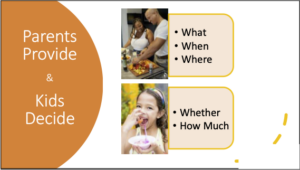
  • Parents Provide, Kids Decide
  • What to Offer
  • When to Offer
  • How Much, How Often

Part 2 – Bringing the Joy Back to Mealtime

  • Where They Eat
  • Trusting Your Child’s Cues
  • Spotting Pressure
  • Bringing Joy Back
  • Before the Meal
  • Activities to Try & When to Get More Help

Plus — Printables You’ll Actually Use

  • Visual meal schedule
  • Sample daily rhythms
  • Snack combination guide
  • Words that help and hinder reference card
  • Kitchen and food play activity ideas

And there’s more — C.H.E.F.S. is included, too.

Your purchase also unlocks C.H.E.F.S. — Cooking, Healthy Eating, and Food Strategies — at no extra cost.

It’s a virtual, self-paced program that builds your basic cooking skills while exploring the health benefits of foods, with a library of 12 culinary nutrition lessons. Getting into the kitchen is one of the most powerful (and fun) ways to expand what your child will eat, and C.H.E.F.S. gives you the how.

The Approach

This whole series is built on responsive feeding — the idea that you and your child each have a job at mealtime, and the magic happens when both of you stay in your lane.

Your job: what, when, and where.

Your child’s job: whether, and how much.

When you trust your child to listen to their body — and trust yourself to provide the structure — mealtimes get a whole lot quieter. Not perfect. But quieter, kinder, and a lot more like the family meals you actually want.

Is This Series for You?

Built for parents and caregivers of children roughly 1–6 years old who are:

  • Refusing foods they used to eat
  • Stuck on a very short list of “safe” foods
  • Making mealtimes stressful for everyone
  • Snacking constantly and barely eating at meals
  • Or just — making you wonder if you’re doing this right

A note on when to seek more support

Picky eating is normal. But sometimes what looks like picky eating is something more — like Pediatric Feeding Disorder or ARFID — and benefits from in-person, individualized care.

If your child is losing weight, has a very limited diet affecting growth or nutrition, gags or chokes frequently, or shows distress around food beyond typical preferences, please reach out — to your pediatrician, a feeding-trained dietitian, an SLP, or an OT.

This series is a wonderful starting point, but it’s not a substitute for individualized clinical care when that’s what’s needed. Your child’s wellbeing comes first.

Get everything — $67

Calmer Mealtimes + C.H.E.F.S. Bundle

One-time purchase • Lifetime access

$67
  • All twelve short lessons (watch in any order, as many times as you want)
  • C.H.E.F.S. culinary program included — 12 culinary nutrition lessons at no extra cost
  • All printables and reference cards
  • Lifetime access — revisit any stage, any time
Get Instant Access

Frequently Asked Questions

How long do I have access?

Forever. Once you buy, it’s yours. Come back when your second kid hits the picky stage, or when you just need a refresher.

My child is older / younger than the age range — will this still help?

The core principles apply across childhood; the specific examples skew toward ages 1–6. If your child is outside that range, the philosophy still translates — some practical examples may need adapting.

Can my co-parent / mother-in-law and I both watch?

Please do — it’s one of the most useful things to watch together. A lot of feeding conflict comes from caregivers being on different pages, and the series gives you a shared vocabulary.

What if my child has a diagnosed feeding issue?

This series is general parent education, not individualized clinical care. If your child has PFD, ARFID, or another diagnosed condition, this can complement professional care but shouldn’t replace it. Please work with your treatment team.

What if it's not a fit?

Because the videos and printables are digital and instantly accessible, we’re not able to offer refunds once you’ve accessed the course. If something isn’t landing, please email us. We’ll troubleshoot, clarify, point you toward more support, or talk through what’s happening at your dinner table. You’re not on your own here.

Not ready yet? That's okay.

Get gentle, occasional emails with feeding tips, recipe ideas, and the kind of "oh, that helps" reminders that show up at exactly the right moment. No spam, no shame, no pressure to buy anything

Want more than videos? Meet Parent Food School.

The Picky Eating Series gives you the foundation — the why, the words, and the tools — on your own time. But some families want more than a course. They want a team in their corner, real people to ask their specific questions, and other parents who just get it. That's Parent Food School. It's our deeper, higher-support program — built for parents who want to go beyond self-paced learning into live guidance and community. Think of the series as the map, and Parent Food School as having a guide walk the trail with you.

Mealtimes can feel different. Starting this week.

You don't have to figure this out alone, and you don't have to wait until things get worse. Short, watchable videos, a handful of printables, and a feeding approach that genuinely works — that's it.